A Special Report on the Battle for the World’s Oil Chokepoints
Editorial Analysis
- There are moments in history when a decision made in Washington changes the strategic map almost overnight.
- For President John F. Kennedy, one of those moments was the Bay of Pigs. And it established a Russian communist strong hold in the Caribbean that haunts us to today.
- For President Donald Trump, history may will record the Houthis advance toward the Bab el-Mandeb Strait as his colossal failure.
Like Kennedy before him Trump withheld Key air support for the legitimate government of Yemen.
The US air force fighters are than less then 10 minuets away at attack speed. Their was no danger to our pilots or aircraft. The Houthis have no SAM’s, no radar. They do not even have antiaircraft guns.
As a result the Houthis 100,000 men strong attacked and conquered. Gaining control of a key waterway.
The comparison is astonishing. Another enemy to America gains a strategically significant stronghold.
The central lesson is worth understanding: air power was requested at a critical moment, Washington declined to provide it, and the battlefield changed.
In 1961, Kennedy blinked he withheld air support at the Bay of Pigs, and history was made. Castro survived and took Cuba. And the communist have been destabilizing the region ever since. Much of the drug narco trade are supported by communists the world over. And their central command center is Cuba.
Same sad story again this time in Yemin. The reluctance of the US military to engage because of political considerations puts America at grave risk.
As the Houthis surged down Yemen’s Red Sea coast, the Saudis begged for U.S.
Air strikes.
Saudi Crown Prince Mohammed bin Salman appealed to Trump for direct American strikes against the Houthis as their forces drove south along Yemen’s Red Sea coast. Trump declined two times. Washington instead offered intelligence and targeting assistance.
Then the Houthis kept moving embolden when thet realized help was not on the way. It’s Trump’s Bay of Pigs. Trump said no, and the Houthis kept moving. They took Mocha, Dhubab and
Perim, right inside the Bab el-Mandeb, along with strategically important territory on the
Red Sea coast.
Look at a map. Bab el-Mandeb links the Arabian Sea and the Red Sea. Around 7% of the
world’s oil output passes through this critical waterway.
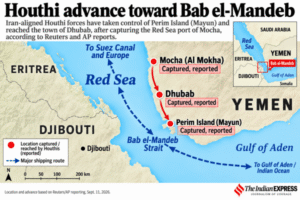
Saudi Arabia and the world desperately needs the Bab el-Mandeb Strait
When Hormuz is too hot, Saudi crude can move west through the East-West pipeline to Yanbu and then out through the Red Sea. That alternative route is now threatened. The human toll is already staggering, and the strategic consequences could be even larger.
From an oil perspective, this is an earthquake.
Hormuz on one side. Bab el-Mandeb on the other. Two of the world’s critical energy choke points are now under extreme pressure: one directly controlled by Iran and the other controlled by the Houthis, Iran’s closest regional ally in Yemen.
They captured Mocha, reached Dhubab, and crossed to Perim Island – Mayun – sitting directly inside Bab el-Mandeb itself. Yemeni government forces withdrew from the island. This wasn’t simply another battle in Yemen. It potentially changed the world’s energy map.
THE TWO GATEWAYS OIL EXITS THE MIDDLE EAST ARE UNDER ATTACK
Look at the map of the Middle East.
On the eastern side of the Arabian Peninsula sits the Strait of Hormuz.
On the western side, at the bottom of the Red Sea, sits Bab el-Mandeb.
Those are two doors through which an extraordinary amount of the world’s energy and commerce must pass.
Iran dominates the strategic environment around the first.
The Iran-aligned Houthis have now dramatically strengthened their position around the second.
That is the sad story we now face. .And the numbers explain why it matters.
Before the Iran war began on February 28, approximately 125 large commercial vessels every day passed through Hormuz – tankers, LNG carriers, bulk carriers and container ships.
That traffic represented approximately 20% of the world’s daily crude-oil and LNG supply.
Now compare 125 ships with what is happening today.
Recent reporting put commodity-vessel traffic through Hormuz in the single digits on some days, with a recent 10-day average around 14 ships per day.
On one recent Wednesday, only seven vessels were recorded transiting Hormuz. One was a VLCC carrying nearly 2 million barrels of crude. There wasn’t a single LNG tanker among those seven ships.
Think about that. 125 ships a day before the war. Now we’re talking about days with seven. That isn’t a minor shipping inconvenience. That is a fundamental disruption of one of the key arteries of the global economy.
SO THE SAUDIS BUILT A BACK DOOR
Saudi Arabia has understood the vulnerability of Hormuz for decades.
That’s why the kingdom built its enormous East-West pipeline, carrying crude from the producing regions in eastern Saudi Arabia across the desert to Yanbu on the Red Sea.
Instead of putting Saudi oil onto tankers in the Persian Gulf and sending them through Hormuz, the crude can travel across Saudi Arabia by pipeline.
Load it onto tankers at Yanbu. Send those ships south through the Red Sea. Then through Bab el-Mandeb and into the Gulf of Aden and Arabian Sea. In other words: go around Hormuz. And that alternative has become enormously important.Recent tracking estimates put Saudi crude and condensate loadings at Yanbu at roughly 2.9 million to 3.7 million barrels per day, depending on methodology.
That is a river of oil coming at a critical time.
But there’s a problem. To get that oil from the Red Sea to the open ocean, those ships have to pass through another narrow doorway:.
Bab el-Mandeb.
And as a direct result of trump withholding critical air support The Houthis just took control os the Straits of Bab el-Mandeb. A colossal screw up on Trupms part. What was he thinking!
THE HOUTHIS
- The Houthis’ advance wasn’t merely about capturing more territory.
- They moved down Yemen’s strategically priceless Red Sea coastline.
- They captured Mocha.
- They reached Dhubab.
- Then fighters moved onto Perim Island.
Perim is only about 13 square kilometers, but that’s irrelevant. Location is everything. The island sits inside Bab el-Mandeb, dividing the strait’s channels. Taking Perim and advancing opposite it on the mainland gives the Houthis a substantially stronger position from which to threaten shipping.
This is the difference between acreage and strategic geography. You don’t need to own half of Yemen to threaten international shipping. You need the right coastline. The right islands.which they now have.
YOU ALSO NEED:
The right missiles.
The right drones.
WHICH IRAN IS GLADLY SUPPLYING
They now have the ability to convince shipowners, captains and insurance companies that sailing through that water could cost them their ship.
HOW MUCH OIL ARE WE TALKING ABOUT?
Before this latest crisis, Bab el-Mandeb was already one of the world’s most important energy arteries. Approximately 4.1 million barrels per day of crude oil and petroleum products passed through Bab el-Mandeb during 2024, according to figures cited in recent reporting. And because Hormuz became so dangerous, Saudi dependence on the western route exploded. Recent reporting indicated Saudi seaborne crude exports through Bab el-Mandeb rose sharply compared with the prior year.
That’s the part of this story the market needs to understand. The alternative route became much more valuable precisely because the primary route became dangerous.
And now the alternative is threatened too.
BAB EL-MANDEB HASN’T STOPPED – YET
This distinction matters.Shipping through Bab el-Mandeb has not collapsed the way Hormuz traffic has just yet. Recent tracking data showed roughly two dozen or more commodity-vessel movements per day, near the recent average. That’s important because it tells us exactly where we are in this story. The catastrophe isn’t that Bab el-Mandeb has already stopped operating. The risk is that the world’s principal alternative to disrupted Hormuz shipping has suddenly become dramatically more vulnerable. That’s a very different – and potentially much bigger – story.
THE SAUDIS UNDERSTOOD THE DANGER.. TRUMP DID NOT
Mohammed bin Salman apparently understood what was happening. The Saudi crown prince called Trump twice begging the United States to strike the advancing Houthis. Trump declined.
Instead, the United States offered Saudi Arabia intelligence and targeting assistance. But wars don’t wait for Washington policy reviews. While Washington was trying to avoid expanding the war, the Houthis were expanding the battlefield.
That’s where my Bay of Pigs comparison begins.
KENNEDY’S BAY OF PIGS
In April 1961, the Kennedy administration inherited an operation designed to overthrow Fidel Castro. Cuban exiles landed at the Bay of Pigs. The operation collapsed. One of the most controversial decisions surrounding the invasion involved American air support. Kennedy refused to escalate into the overt American military intervention necessary to rescue the operation. The result was catastrophic. The invasion failed. Castro emerged stronger. Cuba became even more firmly entrenched in the Soviet camp. Kennedy had attempted to avoid a larger confrontation. Instead, America’s adversaries learned something from his restraint.
The analogy to Yemen is significant.
The strategic question is remarkably familiar: What happens when restraint intended to prevent escalation instead gives your opponent the opportunity to change the battlefield? That is the question Trump may eventually have to answer.
IRAN’S STRATEGIC DREAM HAS COME TRUE
Now look at the map again. Iran sits astride the Persian Gulf. The Strait of Hormuz is the exit. Before this war, roughly one-fifth of global crude-oil and LNG supply depended upon that narrow waterway. Iran has demonstrated that it can dramatically interfere with that traffic. Meanwhile, hundreds of miles west, Iran’s Houthi allies have advanced toward the other great doorway. Bab el-Mandeb. This doesn’t mean Tehran literally controls every ship entering or leaving both waterways. It doesn’t have to. Control isn’t the only weapon. Risk is a weapon. A missile doesn’t have to sink every tanker. It has to convince an insurance company that the next tanker might be sunk. A drone doesn’t have to destroy every port. It has to convince a shipowner that the risk premium has changed.
Shipping economics can do the rest.
Tankers divert.
Insurance premiums explode.
Freight rates rise.
Cargoes arrive late.
Refineries scramble for replacement barrels.
Consumers ultimately pay.
THE SUPPLY DAMAGE IS ALREADY VISIBLE
This isn’t merely theoretical. Recent reporting citing the International Energy Agency said Saudi crude supply fell 2.3 million barrels per day during August, reaching approximately 6 million barrels per day – its lowest level in more than three decades. Brent moved above $100 amid concerns over supply disruptions. But the more important question isn’t where oil trades this morning. It’s what happens if the world concludes that this isn’t temporary. Oil markets can tolerate frightening headlines. They can tolerate isolated tanker attacks. They can tolerate temporary closures. What they cannot easily tolerate is a structural reduction in the reliable transportation capacity connecting Persian Gulf production with world markets.
TRUMP’S FATALLY FLAWED DECISION
Donald Trump faced a choice. The Saudis wanted American air power brought against the Houthi advance. Trump chose not to do it. Trump may have avoided a tactical escalation while permitting a strategic disaster. Because territory matters. Islands matter. Ports matter.Pipelines matter.
And above all: chokepoints matter.
The Houthis didn’t need to conquer Saudi Arabia. They didn’t need to capture Riyadh. They needed to move toward one narrow strip of water through which millions of barrels of oil and thousands of commercial ships must travel.
TWO CHOKEPOINTS
That’s why I believe the market may still be underestimating what has happened. Forget the daily noise. Forget today’s oil quote. Forget whether crude moves up three dollars this morning and gives two dollars back tomorrow. Look at the map.
On one side of Arabia: Strait of Hormuz. Before the war: roughly 125 major commercial vessels every day. Recently: a 10-day average around 14, with some days in the single digits. On the other side: Bab el-Mandeb. Roughly two dozen or more commodity-vessel movements per day recently, with millions of barrels of petroleum historically moving through the waterway and Saudi Arabia relying increasingly heavily on the Red Sea route. Between them sits Saudi Arabia and some of the most important oil infrastructure on Earth. At one end is Iran. At the other is an Iran-aligned armed movement whose territorial position has just improved dramatically.
That is an enormous strategic advantage.
And it happened while Saudi Arabia was BEGGING Washington for help.
DONALD TRUMP’S BAY OF PIGS
That judgment belongs to history. Trump apparently believed refusing direct American strikes against the Houthis would prevent another front from opening in an already dangerous war. But the second front opened anyway. The Houthis advanced. Perim fell.Bab el-Mandeb became substantially more vulnerable. And Saudi Arabia’s escape route around Hormuz suddenly had a potential enemy sitting at its exit. Hormuz in the east.Bab el-Mandeb in the west.
Two doors.
One global oil market caught between them. If this situation continues deteriorating, historians may eventually look back at those two telephone calls from Mohammed bin Salman and ask a very simple question:
IT Was the moment Donald Trump blinked
By Nick Guarino